
A 120 kg crate has to get onto a van floor, 1.5 m up. Two people will tell you two things. Lift it and be done with it, says the first. Get a ramp, says the second, it is far less work.
The second one is half right, and the half that is wrong is the word work. Lifting the crate takes 1,765.2 J. Pushing it up a 15 degree ramp to the same height takes 1,769 J, a difference of two tenths of a percent that exists only because the ramp length got rounded. The ramp saves nothing at all in energy. What it saves is force, and it saves a great deal of it: 304.58 N instead of 1,176.8 N, a factor of 3.86.
That trade is not a coincidence and it is not a rule of thumb. It is an identity. The ramp at 15 degrees is 5.796 m long to gain 1.5 m of height, which is 3.86 times the distance, and it asks for 3.86 times less force. Multiply the two and you are back where you started.
The lift, priced
Start with what the job costs before anyone decides how to do it. Gravitational potential energy is mass times gravity times height, and at 120 kg over 1.5 m that is 1,765.2 J. That number belongs to the crate and the van floor. No technique changes it.
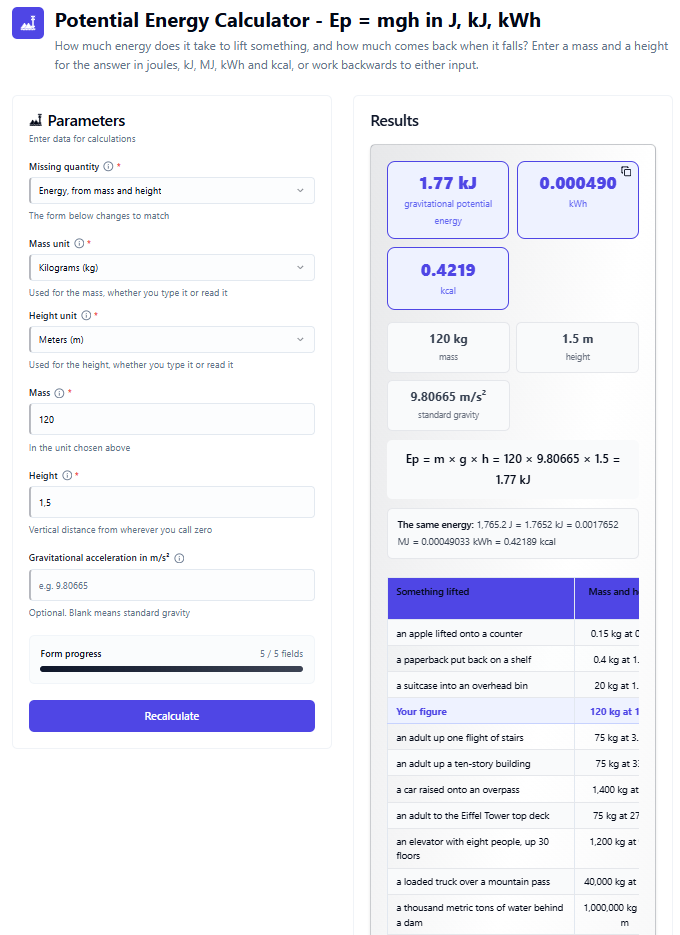
For scale, that is more than seven times the 235.4 J of swinging a 20 kg case into an overhead bin, and about three quarters of what an adult spends climbing one flight of stairs, 2.43 kJ. In food terms it is 0.4219 kcal, which is the uncomfortable part of energy arithmetic: the whole job is worth a tenth of a gram of sugar and it will still make you sweat.
The tool also notes what happens if the crate comes back down uninvited. From 1.5 m it lands at 5.42 m/s, which is 19.5 km/h or 12.1 mph. That is the same 1,765.2 J arriving all at once instead of leaving gradually.
The table that settles it
Here are the two options side by side, on the same crate and the same height. The ramp column assumes 15 degrees, which is a steep loading ramp and about the limit of what one person can push a heavy load up.
| What you are comparing | Lifting it straight up | Pushing it up a 15 degree ramp |
|---|---|---|
| Height gained | 1.5 m | 1.5 m |
| Distance the crate travels | 1.5 m | 5.796 m |
| Force you must produce, ideal case | 1,176.8 N | 304.58 N |
| The same force as a weight you would hold | 120 kgf | 31.06 kgf |
| Work done against gravity | 1,765.2 J | 1,765.2 J |
| Work as the calculator reports it | 1,765.2 J | 1,769 J |
| Extra work if you drag it, wood on wood | none | 1,976.7 J |
| Total if you drag it | 1,765.2 J | 3,742 J |
| Total if it is on wheels | 1,765.2 J | 2,095 J |
| Can one person produce that force | no | yes |
| Equipment needed | a hoist or two people | a plank |
Read the two work rows and then the two total rows, because the whole argument sits between them. In the ideal case the ramp is free. In every real case it is not, and the reason is friction.
Where the ramp wins
When the force is the binding constraint, which it usually is. 1,176.8 N is the weight of 120 kilograms, and nobody lifts that off the floor to chest height alone. 304.58 N is the weight of about 31 kg. That is an ordinary push. The ramp does not make the job smaller, it makes it possible, and those are different achievements that the phrase labor-saving runs together.
When the load must not be dropped. A lift has a failure mode where the crate arrives at 19.5 km/h. A ramp has a failure mode where it slides back down, which is slower, more survivable, and easier to stop with a foot.
When you can put wheels under it. This is the case that changes the answer completely, and it is the one people skip. Rolling resistance of around 0.05 against a sliding coefficient of 0.3 turns the extra work from 1,976.7 J into 329.6 J, and the total from 3,742 J down to 2,095 J. A ramp with a hand truck is a good idea. A ramp without one is a plank you drag things up.
Where the ramp loses
Friction does not care about your height gain. It charges you by the distance, and the ramp gave you nearly four times as much of it. The extra force is the coefficient multiplied by how hard the crate presses into the ramp, which at 15 degrees is 1,136.7 N, so the arithmetic is short:
| How the crate moves | Coefficient | Friction force | Total force up the ramp | Total work |
|---|---|---|---|---|
| Frictionless, the textbook case | 0 | 0 N | 304.58 N | 1,765.2 J |
| On a hand truck or rollers | 0.05 | 56.8 N | 361.4 N | 2,095 J |
| Dragged, wood on wood | 0.3 | 341.0 N | 645.6 N | 3,742 J |
Dragging it costs 2.12 times the energy of simply lifting it. The ramp has stopped being a machine that helps and become a machine that converts your effort into a warm plank. And notice that the force is still only 645.6 N, well inside what a person can push, so the ramp is still winning the argument it was brought in to win. It is losing an argument nobody was having.
The second way to lose is subtler and it is about aim. Push a crate up a ramp and your arms are almost never parallel to the ramp surface. Twenty degrees off is normal, and here is what twenty degrees off costs on this job:
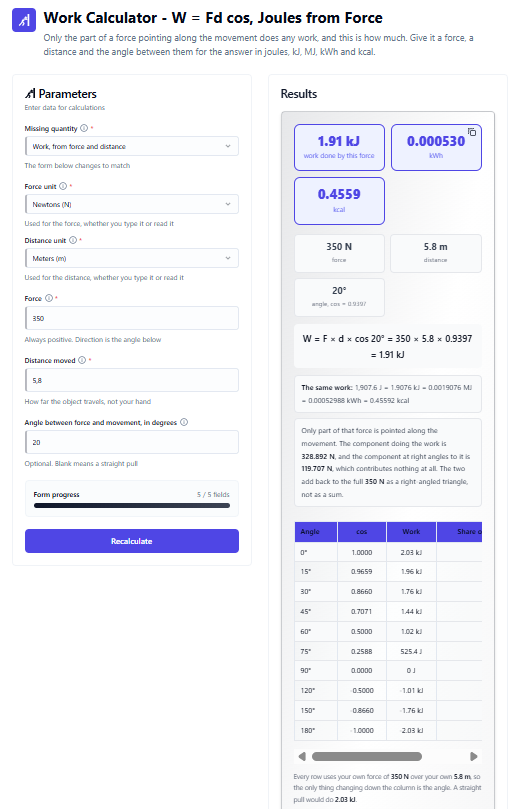
A 350 N push over the 5.8 m ramp at 20 degrees to the surface does 1,907.6 J. Only 328.892 N of that push is going up the ramp; the other 119.707 N is pressing the crate into the boards, doing nothing except making friction worse. Had the same 350 N been aimed straight along the ramp it would have done 2.03 kJ. The angle costs about six percent, and the sweep in that screenshot shows how forgiving the first fifteen degrees are and how fast it collapses after sixty.
The shallow ramp is the wrong instinct
If a ramp trades force for distance, the obvious move is to make it as shallow as possible. Longer plank, gentler slope, less force. That instinct is right about the force and wrong about everything else, and the reason is that friction bills by the distance the ramp just handed you.
| Ramp angle | Length for 1.5 m of height | Force with friction at 0.3 | Total work | Against lifting it |
|---|---|---|---|---|
| 10 degrees | 8.638 m | 552.0 N | 4,768 J | 2.70x |
| 15 degrees | 5.796 m | 645.6 N | 3,742 J | 2.12x |
| 20 degrees | 4.386 m | 734.2 N | 3,220 J | 1.82x |
| 30 degrees | 3.000 m | 894.1 N | 2,682 J | 1.52x |
| 45 degrees | 2.121 m | 1,081.8 N | 2,295 J | 1.30x |
The column runs the wrong way round from what anyone expects. Halving the slope from 20 degrees to 10 nearly halves nothing: the force drops from 734.2 N to 552.0 N, a useful 25 percent, while the total work climbs from 3,220 J to 4,768 J. The friction force barely moves across the whole table, from 347.7 N at 10 degrees to 249.6 N at 45, because it depends on how hard the crate presses into the boards and that changes slowly. What changes fast is how far you drag it.
So the two goals genuinely conflict, and you have to pick one. If you cannot produce the force, go shallow and accept that you are spending the energy of two and a half lifts. If you can produce the force, go steep: a 45 degree ramp costs only 1.30 times the straight lift, and it is the closest a dragged load gets to the honest answer. Put the crate on wheels and the whole table collapses, which is why the table is really an argument for a hand truck.
The clock is the variable nobody quotes
Everything so far has ignored time, and time is where the two options stop being comparable at all. Work says how much. Power says how fast, and it is power that decides whether a person or a motor can actually do the job.
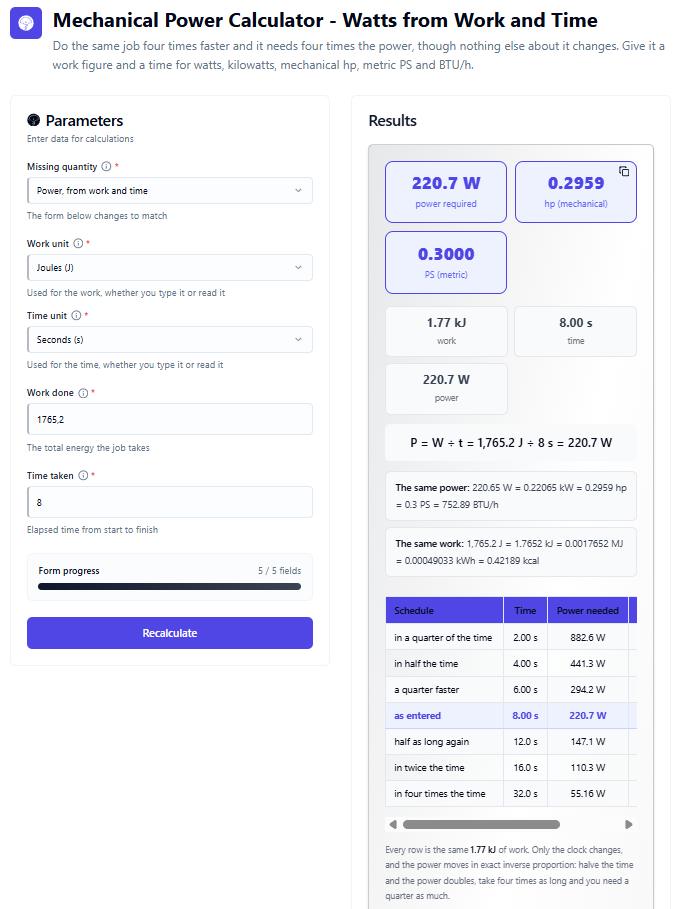
Lift the crate in 8 s and you are producing 220.7 W, which is 0.2959 hp, or 0.3 PS if the specification came from Europe. That sits between a person pedaling steadily at 75 W and a person climbing stairs at 300 W. Take 30 s over it instead and the demand falls to 58.84 W, a factor of 3.75, for a delay nobody would notice.
The schedule table underneath the result makes the trade explicit. The same lift in 2.00 s needs 882.6 W. In 32.0 s it needs 55.16 W. Sixteen times the time, one sixteenth of the power, and the crate ends up in exactly the same place having absorbed exactly the same energy.
Two things follow that are worth more than the ramp argument. The first is that if a winch is marginal, buying time is always cheaper than buying watts. The second is that the calculator reports useful power, and a real machine draws more: at 80 percent efficiency this job needs 275.8 W going in, and at the 25 percent human muscle manages, 882.6 W of metabolic effort. That last number is why lifting a crate in eight seconds feels like a horse's worth of work when the physics says a third of one.
The verdict, which turns on one question
Not whether the ramp saves work. It does not, and no arrangement of planks will make it. The question is what your actual constraint is.
| Your situation | Better option | Why |
|---|---|---|
| One person, no equipment, load over about 40 kg | Ramp | 1,176.8 N is not liftable; 645.6 N is pushable even dragged |
| Ramp available and the load has wheels | Ramp | Total work 2,095 J against 1,765.2 J, an 18 percent premium for a job one person can do |
| Powered hoist already in place | Lift | The ramp's only advantage was force, and the hoist has removed the constraint |
| Many trips, load dragged not rolled | Lift | Every trip pays 3,742 J against 1,765.2 J, and it compounds |
| Energy is genuinely the scarce thing, as on a battery | Lift | The shortest path is the only one with no friction penalty |
| The job has to be done in under two seconds | Neither, on muscle | 882.6 W of useful power is beyond a person however you route it |
The old phrase for a ramp is a simple machine, and machines in that sense were never defined as things that reduce work. They were defined as things that change the force you need to supply it with. The ramp keeps that promise exactly, charges you distance for it, and then friction takes a cut on the way. Which is a fair description of most machines.
Tools discussed in this article
Potential Energy Calculator - the energy stored by raising a mass, solved in any direction, with a reference table running from an apple on a counter to the water behind a dam and answers in joules, kJ, MJ, kWh and kcal.
Work Calculator - work from a force, a distance and the angle between them, with the force split into the part that does the work and the part that does not, and a sweep of the same push across ten angles.
Mechanical Power Calculator - the same job on seven different schedules, in watts, kilowatts, mechanical hp, metric PS and BTU per hour, with the input power a real machine would need at a given efficiency.
More physics tools
Kinetic Energy Calculator - where the 1,765.2 J goes if the crate falls instead of being placed, and why doubling a speed quadruples the energy.
Force Calculator - the 1,176.8 N in this article is a weight, and this is where a mass turns into one, in newtons, kilonewtons, kgf and pounds-force.
Momentum Calculator - what a dropped crate carries into the floor, which is a different quantity from its energy and answers a different question about the damage.