
The project
Three jobs, one afternoon, one bench. A wheel had to come off a car. A 300 kg pallet had to go down a 12 degree loading ramp. A wall clock had been running fast and needed regulating. Nothing exotic, nothing that needed a specialist, and none of the three went the way the obvious measurement said it would.
That is the thread worth following. In each job there is a number your hand reaches for first, and in each job it turned out not to be the number that decided the outcome. The wheel nut did not care how strong the arm was. The pallet did not care how heavy it was. The clock did not care what its bob was made of. Three different pieces of physics, one habit of measuring the wrong thing.
Job one: the nut that would not move
The spec on the wheel was 120 N·m, which is 88.51 lb-ft. That figure is not a description of effort. It is a description of turning effect, and turning effect is a force multiplied by the distance from the center of the nut to where your hand sits. Change the distance and the force needed changes with it, in exact proportion.
On the 250 mm ratchet that was in the toolbox, the required pull is 480.0 N. In terms that settle arguments in a driveway, that is 107.9 lb of force, the weight of 48.9 kg hanging off the end of the handle. Two hands and a lean. On the 150 mm combination wrench that came out first, the same nut needs 800.0 N, which is 81.6 kg. That is most of an adult standing on it, and it is why the short wrench felt like the nut was seized when the nut was simply doing what the spec said.
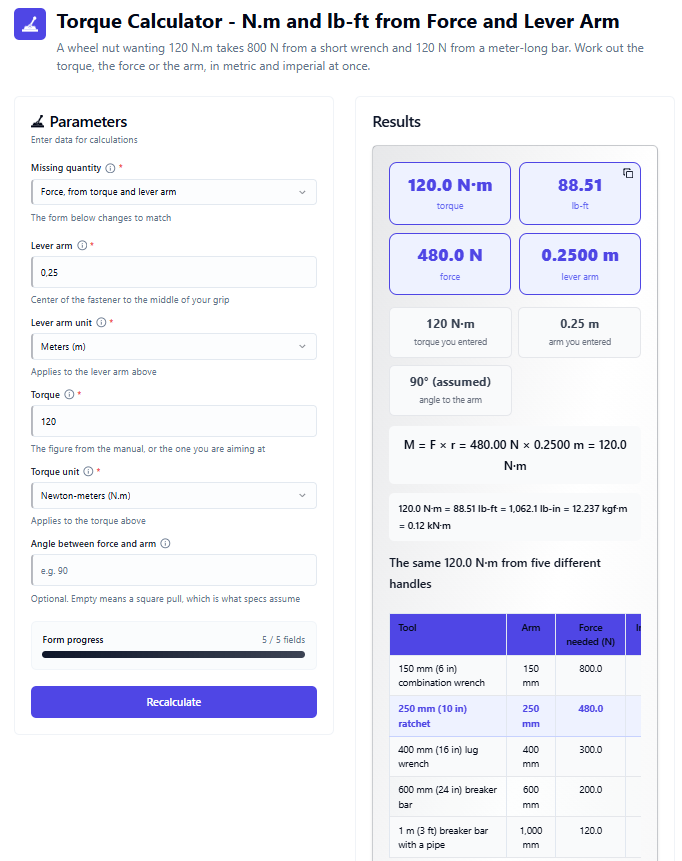
| Handle | Arm | Force needed | In pounds | Hang this much |
|---|---|---|---|---|
| Combination wrench | 150 mm | 800.0 N | 179.8 lb | 81.6 kg |
| Ratchet | 250 mm | 480.0 N | 107.9 lb | 48.9 kg |
| Lug wrench | 400 mm | 300.0 N | 67.4 lb | 30.6 kg |
| Breaker bar | 600 mm | 200.0 N | 45.0 lb | 20.4 kg |
| Breaker bar with a pipe | 1 m | 120.0 N | 27.0 lb | 12.2 kg |
Read that from the bottom up and you have the entire case against the cheater pipe in one line. Going from the short wrench to the meter bar cuts the force by a factor of 6.67. That is wonderful for getting a seized nut moving. It is a disaster on the way back, because your arm has no idea what torque it is producing. It only knows how hard it is pulling. A pull that felt right through the ratchet becomes four times the spec through a long bar, and the nut that would not move is now a stud that will not survive.
Use the bar to loosen. Use a torque wrench to tighten. The arm was never the variable.
Job two: the pallet that did not care what it weighed
The ramp was steel, the angle 12 degrees, the pallet 300 kg. Dry, it stayed exactly where it was put. Gravity was pulling it down the slope with 611.7 N and static friction could supply up to 2,129.5 N, so there was a margin of more than fifteen hundred newtons and nothing to think about.
Then somebody had spilled oil on the ramp, and that changed one number: the static coefficient fell from 0.74 to 0.15. Friction could now hold only 431.7 N against gravity's unchanged 611.7 N. The pallet went, accelerating at 1.46 m/s², because once something is moving only the smaller kinetic coefficient resists it.
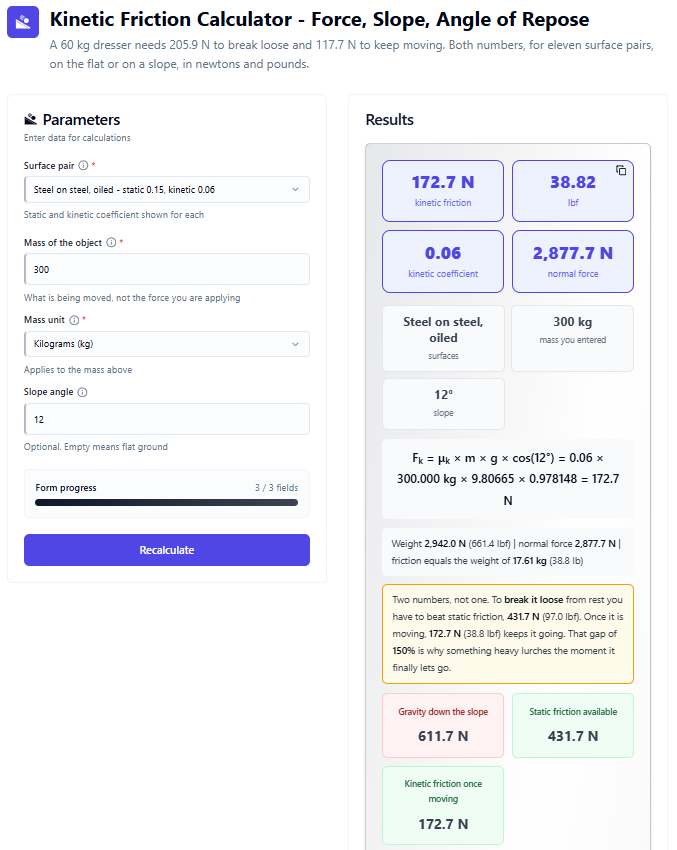
Here is the part that is genuinely counter-intuitive, and it is the reason this job is in the article at all. The weight made no difference whatsoever. Not a small difference. None. Run the same oiled ramp with a 30 kg box and it slides. Run it with a 3 kg box and it slides, and it slides with exactly the same acceleration of 1.46 m/s².
| Load on the oiled ramp | Gravity along the slope | Static friction available | Verdict | Acceleration |
|---|---|---|---|---|
| 300 kg pallet | 611.7 N | 431.7 N | slides | 1.46 m/s² |
| 30 kg box | 61.2 N | 43.2 N | slides | 1.46 m/s² |
| 3 kg box | 6.1 N | 4.3 N | slides | 1.46 m/s² |
Both columns shrink by the same factor, so their ratio never moves, and the ratio is the whole question. Whether something stays on a slope is decided by two things only: the angle, and the pair of surfaces. Mass cancels out of the comparison completely. The threshold has a name, the angle of repose, and it is the arctangent of the static coefficient. Dry steel on steel gives 36.5 degrees. Oiled, it gives 8.5 degrees. The ramp never moved. Someone spilled oil, and a surface that would have held a load on a staircase became one that lets go on a wheelchair ramp.
The instinct on a loading ramp is to look at how heavy the thing is. It is the wrong instinct, and it is wrong in a way that is worse than useless, because a light box on a slick slope feels safe and behaves exactly like the heavy one.
Job three: the clock that ran fast
The clock had a pendulum a meter long. Small-angle theory says it should take 2.006 s to swing there and back, and the first instinct was to suspect the bob. It is a heavy brass disc. Surely a heavier bob swings differently.
It does not. Mass does not appear anywhere in the equation. A lead bob and a cork bob on the same string keep the same time, because gravity pulls harder on the heavier one in exactly the proportion that makes it harder to move. What decides the period is the length, and the length gets in under a square root, which is why the intuition fails twice. Doubling the length does not double the period, it multiplies it by about 1.41. A four meter pendulum takes 4.013 s, exactly double the one meter figure, because it is four times as long and not twice.
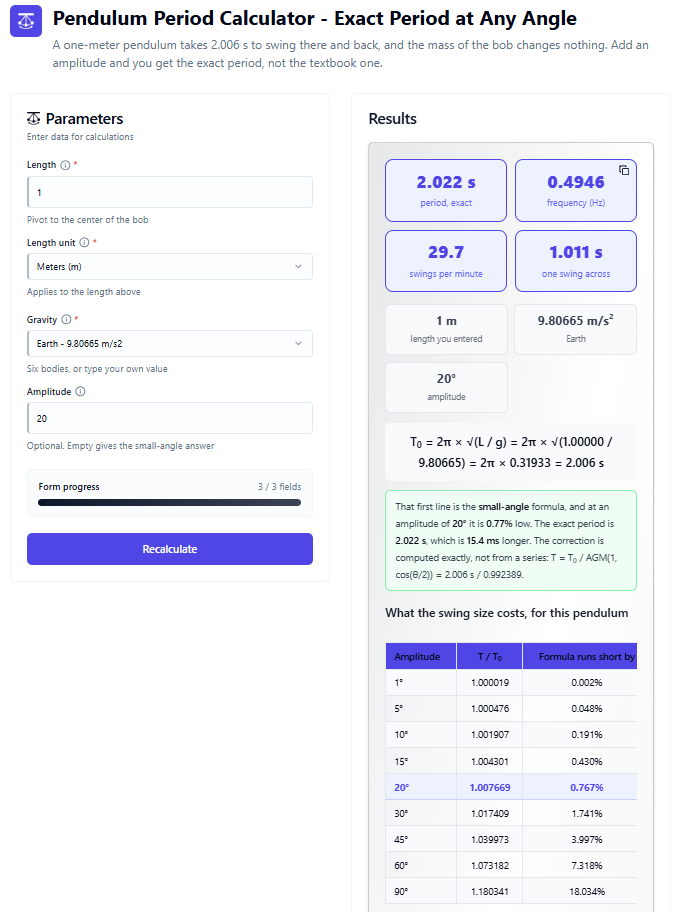
There is a second correction that clock people know and physics classes usually skip. The famous formula is an approximation, exact only for a vanishingly small swing. This clock swung about 20 degrees to each side, and at that amplitude the true period is 2.022 s, which is 15.4 ms longer than the textbook answer. That is 0.77 percent, and a clock running 0.77 percent off gains or loses roughly eleven minutes a day. The formula was not wrong. It was answering a question about a pendulum swinging through almost nothing, and this one was not.
For anyone who wants the length that ticks once per second, it is 99.4 cm, and its period is two seconds, because one tick is half a cycle. That figure came within a whisker of defining the meter, which is why it lands so close to one. A pendulum with a one-second period is a different and much shorter object at 24.8 cm, and confusing the two is the commonest mistake in this corner of physics. The ready-made pages for a 36 inch pendulum and a 39 inch pendulum sit either side of it, and the gap between them is most of what a clock adjustment is.
The reckoning
Three jobs, three instincts, three misses.
| Job | What the hand reaches for | What actually decides | Size of the miss |
|---|---|---|---|
| Wheel nut at 120 N·m | How hard you can pull | Length of the handle | 6.67 times between the shortest and longest tool |
| Pallet on a 12 degree ramp | How heavy the load is | Angle and the surface pair | Weight changes the answer by nothing at all |
| Clock pendulum, 1 m | What the bob is made of | Length, and the swing angle | Mass: zero effect. Amplitude: 15.4 ms |
Four things worth taking away
One. A torque figure is not an effort figure. It is a force and a distance multiplied together, and you control the distance completely. Anyone quoting a spec in newton-meters without saying what they were holding has told you half a fact.
Two. On a slope, weight is a distraction. Whether something stays put is arctan of the static coefficient against the angle, and both sides of that comparison scale with mass, so mass drops out. Check the surface and the angle. Do not weigh the box.
Three. Static and kinetic friction are different numbers and they answer different questions. Static decides whether it starts. Kinetic decides what happens once it has. On oiled steel they are 0.15 and 0.06, a factor of two and a half, which is exactly why a load lurches the moment it finally lets go.
Four. A formula that quotes four decimals is not the same as a formula that has four decimals of accuracy. The pendulum equation prints milliseconds while quietly carrying a 0.77 percent error at an ordinary swing. The decimals were real. The assumption underneath them was not.
Where the same thing keeps happening
The pattern is not really about wrenches, ramps or clocks. It is that the quantity which feels most physical, the one you can lift or strain against, is very often the one the mathematics has already cancelled out. Mass leaves the pendulum equation entirely. It leaves the slope comparison entirely. Force stays in the torque equation but only as half of a product whose other half is a length you chose without thinking. Reaching for a calculator here is not about arithmetic being hard. It is about finding out which number the problem is actually made of, which is usually not the one that made you sweat.
Tools discussed in this article
Torque Calculator - the turning effect of a force on a handle, in newton-meters and pound-feet, with the pull each of five real tools would demand and the mass you would have to hang off the end to produce it.
Kinetic Friction Calculator - friction on the flat or on a slope, with the static and the kinetic coefficient kept apart, and both threshold angles named for what they actually mean.
Pendulum Period Calculator - period, frequency and swings per minute from a length and a gravity, and the exact period once you tell it how far the thing actually swings. Ready-made for a 6 inch pendulum, 12 inch, 18 inch, 24 inch, 30 inch and 48 inch.
More Physics tools
Force Calculator - where the numbers in all three jobs come from, whether it is a mass being accelerated or a weight hanging on the end of something.
Work Calculator - friction multiplied by distance is the energy the surface takes off you, priced in joules.
Mechanical Power Calculator - the same job with a clock attached, and the answer to how big a winch has to be.
Potential Energy Calculator - what a load at the top of a ramp is holding before anybody lets go of it.
Kinetic Energy Calculator - what the pallet was carrying by the bottom of the slope, once friction had stopped being enough.
Momentum Calculator - the other thing a moving load carries, and the reason a sharp shock loosens a fastener that steady pressure will not.