
A man is standing in a doorway. He is shot in the chest and thrown backwards off his feet, through the frame, into the room behind him. Everyone has seen it a few hundred times and nobody in the audience ever objects, because it looks like what a bullet ought to do.
It is not what a bullet does. A 9.5 g rifle bullet leaving the muzzle at 830 m/s carries 7.885 kg m/s of momentum. A sprinter, 80 kg at 10 m/s, carries 800. That is a factor of a hundred and one, in favour of the man in spikes.
There is a second way to see it that needs no calculator at all. Momentum is conserved, so whatever the bullet delivers to the target, the rifle delivered to the shooter's shoulder a fraction of a second earlier. If the round could throw a man across a room, firing it would throw the person who fired it just as far.
Three physics calculators went live on liczgrupa.pl today, and between them they explain why that scene is wrong and why five other things that sound obvious are wrong with it. Every number below came out of one of the three.
Myth: a bullet hits harder than anything a person can do
The momentum figures above are only half of it. The Kinetic Energy Calculator settles the other half, and it does not rescue the bullet either.
| Body | Mass and speed | Momentum | Kinetic energy |
|---|---|---|---|
| Rifle bullet | 0.0095 kg at 830 m/s | 7.885 kg m/s | 3.27 kJ |
| Sprinter at full speed | 80 kg at 10 m/s | 800 kg m/s | 4.00 kJ |
| Tennis serve | 0.058 kg at 60 m/s | 3.48 kg m/s | 104.4 J |
The sprinter wins on momentum by a hundred to one and on energy as well, 4.00 kJ against 3.27 kJ. And yet one of those two is lethal and the other is a rugby tackle. Neither quantity in the table is what separates them.
What separates them is where the energy lands and how long it takes to arrive. The sprinter spreads his over a whole shoulder across perhaps a tenth of a second. The bullet delivers a comparable amount through a few square millimeters in well under a millisecond. Same order of energy, six orders of magnitude difference in concentration, and concentration is the entire story. Hold on to that, because it comes back twice more before the end.
Myth: twice the speed is twice the crash
This one is more expensive than the film scene, because people act on it. It comes from the fact that everything else in daily life is proportional. Twice the distance is twice the fuel. Twice the shopping is twice the bill. Kinetic energy is not built that way: the velocity is squared, so it compounds against itself.
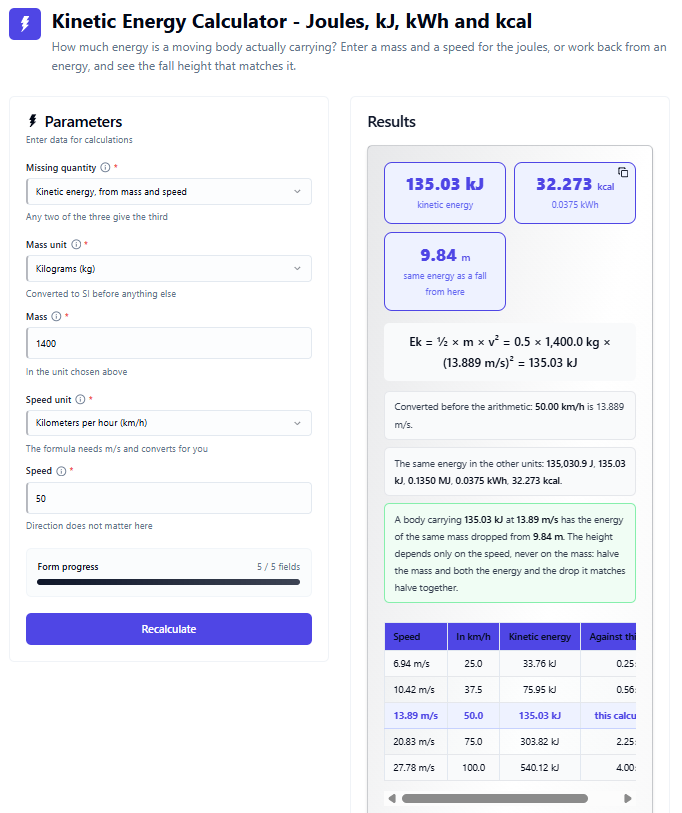
The same 1,400 kg car, nothing changed but the speedometer:
| Speed | In mph | Kinetic energy | Against 50 km/h | Equivalent drop |
|---|---|---|---|---|
| 30 km/h | 18.6 | 48.61 kJ | 0.36x | 3.54 m |
| 50 km/h | 31.1 | 135.03 kJ | 1.00x | 9.84 m |
| 70 km/h | 43.5 | 264.66 kJ | 1.96x | 19.28 m |
| 90 km/h | 55.9 | 437.50 kJ | 3.24x | 31.87 m |
| 110 km/h | 68.4 | 653.55 kJ | 4.84x | 47.60 m |
| 130 km/h | 80.8 | 912.81 kJ | 6.76x | 66.49 m |
Read the last column rather than the third. At 50 km/h a crash into something immovable is a fall from the third floor. At 130 km/h it is a fall from the twentieth, and nothing in any car has ever been designed for that.
The middle of the table is where the practical point sits. Going from 30 to 50 km/h adds 86.42 kJ. Going from 110 to 130 km/h, exactly the same twenty kilometers an hour, adds 259.26 kJ. Three times as much, for the identical movement of your right foot. The last increment of speed is always the expensive one, and it is expensive in a way that does not feel like anything from the driver's seat.
Myth: the energy has to go somewhere, so a crash cannot destroy it
Half right, and the half that is wrong is the useful half. Energy is conserved in the universe. Kinetic energy, the energy of things moving, is not conserved in a collision at all, and in most collisions almost none of it survives.
Two cars meeting head on, 1,200 kg at 20 m/s against 1,500 kg at -15 m/s, bumpers locking so they move off together, through the Momentum Calculator:

They leave the impact together at 0.5556 m/s, barely moving. Of the 408,750 J the two cars brought, 408,333.3 J is gone. That is 99.9 percent, and it left as heat, as noise and as steel that will never go back to the shape it was.
Now look at the row above it in the output. Momentum before: 1,500.0 kg m/s. Momentum after: 1,500.0. Unchanged, to the last digit, in the same event that destroyed nearly all the energy. That is the difference between the two quantities in one screen, and it is why a crash needs both to be understood: momentum tells you where everything ends up, energy tells you what it cost to get there.
Myth: a heavier car is safer
Safer for the people inside it. That much is true and it is why the belief persists. The heavier body changes velocity less in the same collision, so its occupants are decelerated more gently.
But momentum is conserved, and conservation is not a preference. Whatever the heavy car declines to absorb has not vanished; it has been handed to the other vehicle. Run the same pair as an elastic collision instead, where the two separate rather than lock, and the calculator shows the lighter car arriving at +20 m/s and leaving at -18.889 m/s. It has been turned around and sent back at almost the speed it came in with.
People read that number as a mistake, so it is worth saying what it is. An elastic collision reverses the closing speed, not each car's speed over the ground. The two were approaching at 20 minus -15, so 35 m/s. Afterwards they separate at 16.111 minus -18.889, which is 35 m/s again. Nothing was created. The mass difference decided which of the two got to keep its direction.
Myth: a big impulse means a big force
These two get used as synonyms and they are separated by time, which is the only variable in this article you can actually design around.
Take that 1,400 kg car at 50 km/h. Bringing it to a stop needs an impulse of 19,444.4 N s, and no arrangement of brakes, walls or airbags changes that figure by a single unit. What changes is how long you take.
| How it stops | Contact time | Impulse | Average force |
|---|---|---|---|
| Braking normally | 4 s | 19,444.4 N s | 4,861.1 N |
| Hard emergency stop | 2 s | 19,444.4 N s | 9,722.2 N |
| Into a wall | 0.12 s | 19,444.4 N s | 162,036.7 N |
The impulse column never moves. The force column spans a factor of thirty-three. Every piece of safety engineering in a modern car is an attempt to buy milliseconds in that last row: the crumple zone, the airbag, the collapsible steering column, the belt that pays out under load. None of them reduce the impulse, because the impulse is fixed by how fast you were going. They stretch the time, and the force falls in proportion.
This is the concentration idea from the bullet, arriving the second time. There it was concentration in space. Here it is concentration in time. Both are the same trick played on the same fixed quantity.
Myth: weight and mass are two words for the same thing
In a shop they are, and nothing goes wrong. In the second law they are different quantities in different units, and mixing them is the most common single reason an answer comes out roughly ten times too big.
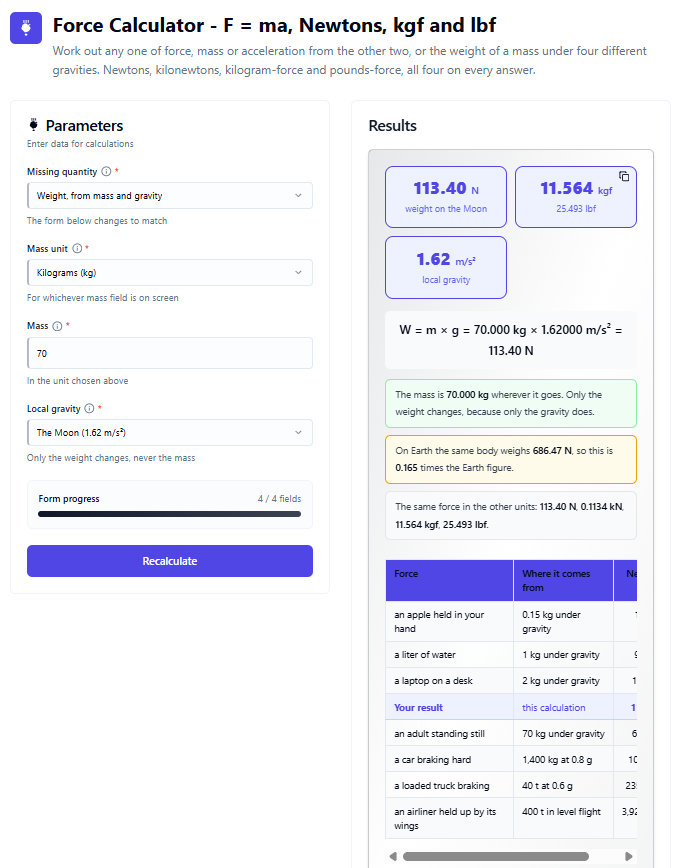
The Force Calculator puts the two side by side. A 70 kg body weighs 686.47 N on Earth and 113.40 N on the Moon, which is 0.165 of the Earth figure. The mass column does not move. It is 70 kg in both places and it would be 70 kg falling through empty space.
Your bathroom scale, incidentally, cannot weigh you in kilograms and does not try. It measures the force you press into it, divides by Earth gravity and displays the mass that force implies. Take it to the Moon and the reading would be wrong while your mass sat there unchanged. Any mass gives the same answer the same way: 50 kg, 80 kg and 100 kg are all just that number multiplied by 9.80665.
The one that turns out to be true
Here is a claim that sounds like the same species as the five above, gets the same eye-roll, and holds up completely: how fast you drive matters far more than how much weight you are carrying.
It sounds like a slogan. It is arithmetic. Load that 1,400 kg car with four passengers and their luggage, call it 1,900 kg, and at 50 km/h the energy goes from 135.03 kJ to 183.26 kJ. Thirty-six percent more, for five hundred kilograms.
Now empty the car again and drive it at 100 km/h instead. 540.12 kJ. Four times as much, from a change that costs you nothing and takes ten seconds. The passengers are a rounding error next to the right foot, and that is not an opinion about road safety, it is what happens when one input is linear and the other is squared.
What the three of them are actually for
Momentum, force and energy describe the same moving object and answer three different questions about it, which is why treating them as synonyms goes wrong so reliably. Momentum asks where everything ends up and always gets a straight answer, because it survives every collision intact. Energy asks what the event cost, and in a crash the answer is nearly all of it. Force asks how bad it was for the thing in the middle, and that one depends entirely on a number nobody thinks about until the moment it matters, which is how long the whole business took. The bullet, the wall and the airbag are all the same lesson told three times: it is never the total that hurts you, it is how tightly the total is packed.
Tools discussed in this article
Momentum Calculator - momentum of one body, the impulse that changes it, and a one-dimensional collision solved as both a perfectly inelastic and an elastic case, with the average force during contact if you give it a contact time.
Force Calculator - any one of force, mass and acceleration from the other two, plus weight under four different gravities, with every answer in newtons, kilonewtons, kilogram-force and pounds-force.
Kinetic Energy Calculator - energy, mass or speed from the other two in five different units, with the same body shown at five speeds and the fall height that carries the same energy.
Ready-made weight conversions
The force calculator has a set of pages for the conversion people look up most often, a mass in kilograms turned into a weight in newtons: 1 kg, 5 kg, 10 kg, 20 kg, 60 kg and 90 kg.
More tools that use the same numbers
Physics is a new category on the site and these three are the whole of it so far. Everything below sits in Automotive and runs on the quantities this article has been about.
Braking Distance Calculator - how much road it takes to supply the impulse that stops a car, once reaction time is added to the arithmetic.
Centripetal Force Calculator - the same second law applied to a corner, where the acceleration points sideways and the tires have to pay for it.
0-100 km/h Acceleration Calculator - the other end of the problem, how long it takes to put the energy into a car in the first place.
Speed Converter - km/h, mph and m/s in both directions, for when the speed arrives in the unit the formula does not want.
Average Speed Calculator - distance over time, which is usually where the velocity in all three formulas actually comes from.
Vehicle Weight Converter - kilograms, tons and pounds in both directions, for the mass that goes in at the top.