No, and the character count cannot tell you. Fifty-six capital W characters measure 98.3 width units, which is 172 percent of what a search result gives a title. Fifty-six characters of the word "illinois" measure 38.0 units, or 67 percent. Same count. Two and a half times apart. One gets cut in the middle, the other leaves a third of the line empty for the engine to fill with something you did not write.
That is a narrow observation about typography. What makes it worth an article is that the same shape of mistake shows up in two other places we shipped today, and in both of them it is more expensive.
Where the width actually goes
A capital W is about 3.56 times the width of a lowercase i. Proportional type has worked this way since metal, and nothing about a search result changed it. So a budget expressed in characters is a budget expressed in the wrong unit, and how wrong depends entirely on what you wrote.
| Title text | Characters | Width units | Of budget |
|---|---|---|---|
| WWWWWW... (56 capitals) | 56 | 98.3 | 172% |
| illinois illinois illinois... | 56 | 38.0 | 67% |
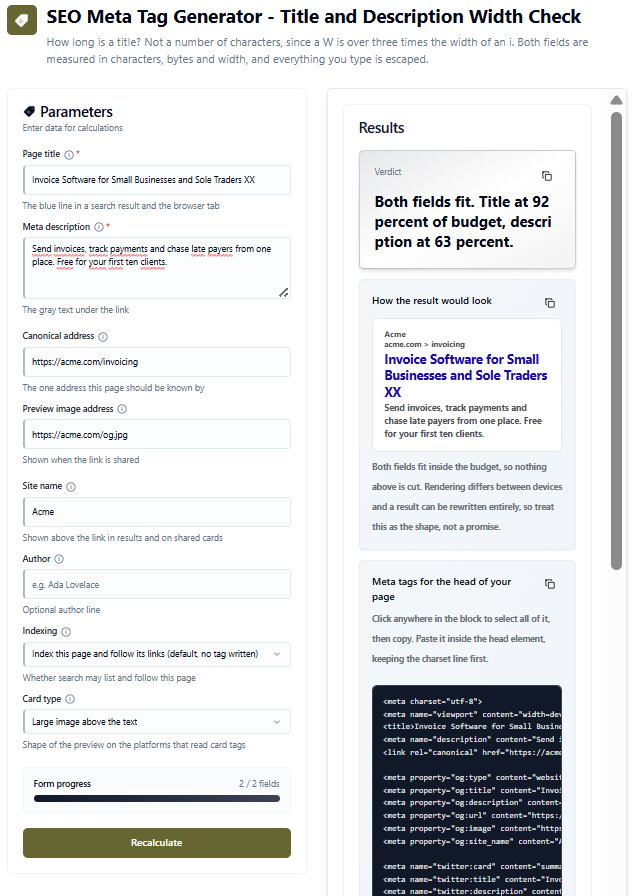
| Invoice Software for Small Businesses and Sole Traders XX | 57 | 52.3 | 92% |
| UUID Generator - v4, v7 and v5 with a GUID Inspector | 52 | 47.9 | 84% |
The third row is the honest middle: ordinary English prose, 57 characters, 92 percent of budget. That is where most real titles land, which is why the sixty-character rule of thumb survives at all. It works right up until you write something with a lot of capitals or a lot of narrow letters, and then it quietly stops working and nothing tells you.
The SEO Meta Tag Generator reports all three numbers at once: characters, UTF-8 bytes and width units against the budget. The bytes matter separately, because a title in a language with accented characters costs more bytes than it costs characters, and some tooling still counts bytes.
The same question, asked of a link
Now take a tracked campaign address. Here the count is irrelevant and something else takes its place: position. Put the campaign parameters after the # and they are not merely in the wrong order, they never leave the browser. Everything after a fragment marker is handled client side and never reaches the server, so it never reaches your reporting either.
Build the same link with an anchor in it and the parameters land before the fragment:
https://acme.com/pricing?utm_source=acme-newsletter&utm_medium=email&utm_campaign=launch#plans
Two more things happen quietly. A destination that already carries utm_source=old has that parameter stripped and rebuilt from the fields, because a duplicated parameter is read differently by different tools and you do not want to find out which. And Acme-Newsletter becomes acme-newsletter, because reporting treats Facebook and facebook as two separate sources and splits one campaign across two rows in the table you were going to screenshot.
What if you change only the medium?
This is where it stops being tidy. The default channel grouping is a set of pattern rules, and the same destination with the same source lands in a different bucket depending on a single word. With acme-newsletter as the source:
| utm_medium | Default channel group | Reading |
|---|---|---|
email | What you expected | |
cpc | Paid Other | Paid, but the source is not a known ad network |
social | Organic Social | Matches the organic social pattern |
referral | Referral | Matches |
affiliate | Affiliates | Matches |
organic_social | Unassigned | Underscore, not the expected form |
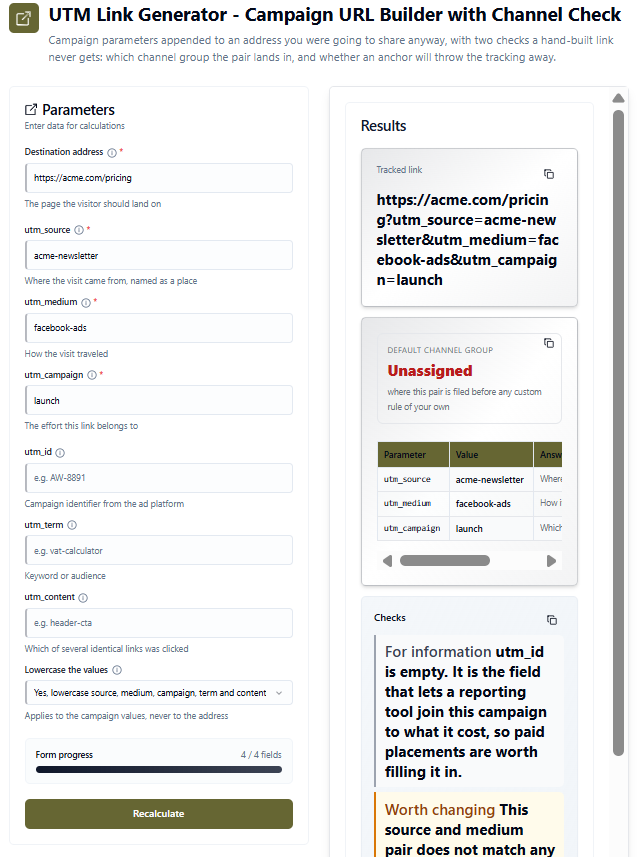
facebook-ads | Unassigned | Descriptive, matches no pattern |
newsletter | Unassigned | Reads like a medium, is not one |
Three of those eight are sensible words a sensible person would type, and all three produce Unassigned. facebook-ads is the one that catches people, because it is more descriptive than cpc and more honest about what the traffic is. It is also invisible in the channel report.
And the medium does not decide alone. Swap the source to facebook and cpc stops being Paid Other and becomes Paid Social, because the grouping reads the pair. Which means the answer to "what medium should I use" is never available in isolation, and a builder that names the resulting group before you publish is worth more than a convention document nobody opens. That is what the UTM Link Generator prints under every link it makes.
Two characters out of thirty-six
Third case, and the clearest one. A UUID is 36 characters. Thirty-two hexadecimal digits and four hyphens that carry no information whatsoever, which is why the unhyphenated form is the same value written more compactly.
Of the 32 that do carry something, exactly two positions are structural. Character 15 is the version. Character 20 is the variant. That is the whole contract. A version 4 identifier always has a 4 at position 15 and one of 8, 9, a or b at position 20, and anything failing those two checks is a string shaped like a UUID rather than a UUID.
The consequence is worth sitting with: a generator that fills all 128 bits at random and writes no markers produces a value that fails the variant check about a quarter of the time, because only two of the eight possible patterns at that position are the standard variant. It will look completely fine in a database column.
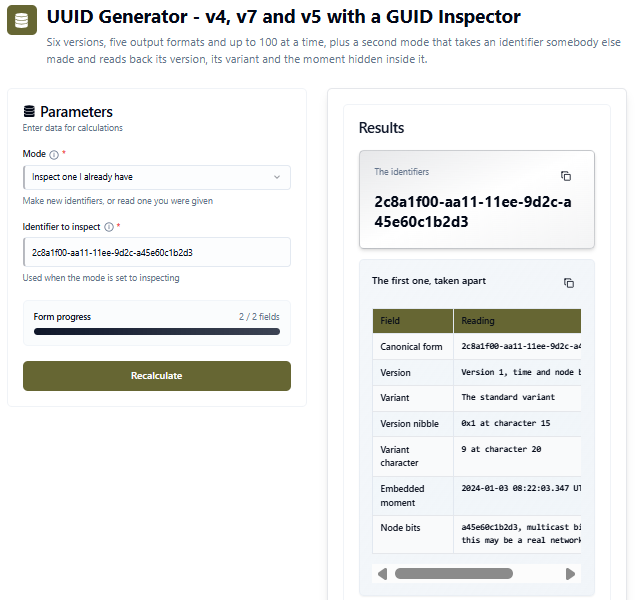
Paste one into the inspector and it reads the positions back. Give it 2c8a1f00-aa11-11ee-9d2c-a45e60c1b2d3 and you get version 1, standard variant, the exact moment it was created, and a warning about the node field: its multicast bit is clear, which means those twelve characters may be the network card of the machine that made it. That identifier has been carrying a timestamp and a hardware address to everyone who ever received it.
What if they have to sort?
Here the version choice stops being academic. Generate six identifiers and sort them as plain text:
| Version | Where the bits come from | Sorts as text | What it gives away |
|---|---|---|---|
| Version 4 | 122 random bits | No | Nothing |
| Version 7 | 48 bits of Unix milliseconds, a counter, then 74 random | Yes | The creation moment |
| Version 1 | 100-nanosecond ticks since 1582, clock sequence, node | No | The moment, often the machine |
| Version 5 | SHA-1 of a namespace and a name | No | Nothing, unless the name is guessable |
Six version 7 identifiers sorted as text come back in the order they were made. Six version 4 identifiers do not, and that is not a curiosity: it is why a table keyed on version 4 fragments its index. Every insert lands in a random place, pages that were cold get touched, and the effect grows with the table. Version 7 exists to fix precisely that and gives up one thing in exchange, which is that the creation time is now readable by anyone holding the value.
If you are seeding rather than designing, the count is the only question, and the answer is a batch: five, ten, twenty-five, fifty or a hundred at once, returned as plain lines with no markup so the whole block pastes into a fixture file.
On collisions, the arithmetic is less dramatic than the folklore. Version 4 has about 5.3 x 10^36 distinct values and reaches an even chance of a single repeat after roughly 2.7 x 10^18 identifiers. At a million a second that is over eighty thousand years. It is the same birthday-problem shape you get whenever you count how many ways a set can be drawn from, which the combinations and permutations calculator works through if you want to see the formula rather than take the number.
What if the same input has to give the same answer?
Every version above draws. Version 5 computes. It hashes a namespace and a name together and truncates, so the same pair returns the same identifier on any machine, in any language, forever. Hash www.example.com in the DNS namespace and you get 2ed6657d-e927-568b-95e1-2665a8aea6a2, which is the value the specification itself publishes, so you can check the implementation rather than trust it. Hash liczgrupa.pl and you get a62d1cd5-f3af-53ff-892f-2ff099b09f12, today and next year.
That makes it the only version you can use to turn something you already have into a stable identifier without storing a lookup table. It also makes it the one version where asking for ten is meaningless, and the generator says so instead of printing the same value ten times.
So what actually counts?
Not the character count, in any of the three cases. In a title the unit is width, and two strings of identical length can sit at 67 and 172 percent of the same budget. In a tracked link the unit is position and pairing: one # in the wrong place empties the report, and one plausible word in the medium field sends a real campaign to Unassigned. In an identifier the unit is position again, two characters out of thirty-six carrying the entire contract while the other thirty-four are decoration or randomness.
What the three have in common is that none of them fails loudly. The title renders. The link works and takes people to the page. The identifier saves into the column without complaint. The failure is in a report you read three weeks later, or an index that got slow without anyone noticing, and by then the string has been copied into a hundred places. Measuring at the point of writing costs about four seconds. That is the entire argument.
Tools discussed in this article
SEO Meta Tag Generator - writes the head tags for a page and measures the title and description three ways, in characters, in UTF-8 bytes and in rendered width against the budget, then draws the search result so you can see where it would be cut. Everything you type is escaped, so a quotation mark in a title cannot end an attribute early.
UTM Link Generator - builds the tracked address, places the parameters before any anchor, strips campaign parameters the destination already carried, lowercases what should be lowercased, and names the default channel group the pair will land in before you publish it.
UUID Generator - six versions in five output formats, up to a hundred at a time, with a second mode that takes an identifier somebody else made and reads back its version, its variant, the moment inside it and whether the node field looks like real hardware.
More code and random tools
QR Code Generator - links, Wi-Fi networks and contact cards encoded in your browser and drawn as vector, with the version, module count and mask reported.
Barcode Generator - EAN-13, EAN-8 and UPC-A with the check digit worked out term by term.
Password Generator - the right tool for the job a UUID should not be given, a value that has to be unguessable rather than merely unique.
Random Number Generator - a plain draw between two bounds, when an identifier would be overkill.
More text tools
Table Generator - turns a pasted range into a rendered table, Markdown, HTML and a plain text box at once.
Business Name Generator - candidates built from an industry vocabulary, each with its character count and domain form.
Lorem Ipsum Generator - placeholder copy by word, sentence or paragraph count, with the character budget it consumes.
Anagram Generator - rearranges the letters of a word and counts how many arrangements exist.
Palindrome Generator - checks a phrase both ways and shows where the first mismatch falls.